

How To Identify HiPo Employees: Panning For Gold via Potential and Performance
True recognition of a HiPo team member requires identifying those vital few with the essential qualities that render them invaluable in navigating the organisation to excellence. The problem is that misidentification can be a VERY costly exercise.
(Updated: )

Christine Reynolds
Director of Talent Management at DoThings.
Identifying High-Potential (HiPo) talent is much like panning for gold; it demands meticulous sifting and refining to accurately pinpoint those critical few destined for pivotal leadership positions that will drive business success. However, grasping the true essence of a HiPo employee is often obscured by corporate jargon and common misconceptions, leading to misidentification and diminished returns on costly development programs. True recognition of a HiPo team member requires identifying those vital few with the essential qualities that render them invaluable in navigating the organisation to excellence. The challenge lies in distinguishing genuine gold from the mere glitter of a shiny distraction.
The Value of HiPo Employees: 91% More Valuable!
High Potential (HiPo) employees are the linchpins of future organisational success. Their unique blend of exceptional performance and leadership potential makes them invaluable assets. Equating to just 3-5% of your workforce, they are often reported as being 91% more valuable than the average employee, and drive 400% more productivity. These individuals are often described as indispensable, ideal future leaders destined to take on roles that are imperative to the business. They are the team members that should be mapped to crucial projects and will often innovate solutions to shape the company’s bright future.
Every penny invested in a HiPo reaps extraordinary returns. Here’s why: Driving Innovation and Competitive Agility: HiPos possess the innate ability to navigate through ambiguity and drive innovation. They are reported to exert 21% more effort than their counterparts, synonymous with Pareto’s Principle, commonly known as the 80:20 principle, where roughly 80% of business value comes from 20% of the workforce (the “vital few”). Their forward-thinking mindset, learning agility, and willingness to challenge the status quo make them essential to help organisations pivot effectively in response to changing industry landscapes.
Fostering a High-Performance Culture: A HiPo's commitment to achieving and exceeding goals permeates the organisation. Their strong social aptitude enables them to foster collaborative team environments, whilst their presence is a performance enhancer, stated to boost team performance and productivity by an additional 15%.
Securing the Leadership Pipeline: Identifying and developing HiPo employees is crucial for succession planning. By investing in their growth, organisations ensure a reservoir of ready leaders to fill key roles, safeguarding against leadership gaps that can disrupt business continuity.
Decoding HiPo Identification: Moving Beyond Gut Instinct
The quest to identify true High Potential (HiPo) employees often veers off course, nominations are frequently guided more by managerial gut instinct or length of tenure rather than a rigorous, data-driven approach. This traditionally ineffective method of selection contributes to a startling statistic, that being, 73% of HiPo Development Programmes fail to achieve their intended ROI or impact business outcomes. Even more alarming, statistics reveal that about one-third of employees designated as HiPo are misclassified, leading to considerable misallocation of development resources.
Identification Issues: Look Beyond the Top Row
While the 9-box grid serves as a essential tool in visualising the talent landscape of staff’s Performance and Potential, it's important to note that not everyone classified as high on the Potential Y-axis automatically qualifies as 'HiPo'. The top row of the 9 box grid are your team members who have high Potential to take on a more complex role or additional responsibilities but they are not all considered HiPo staff.
The 'Enigma' talent box within the 9 box grid serves as the perfect cautionary tale. It highlights individuals who show high sparks of Potential yet fall short in their Performance, which is rated as significantly lagging behind expected standards. These individuals, despite their Potential rating, are not typically those into whom a business would invest substantial development resources or consider for immediate leadership elevation.
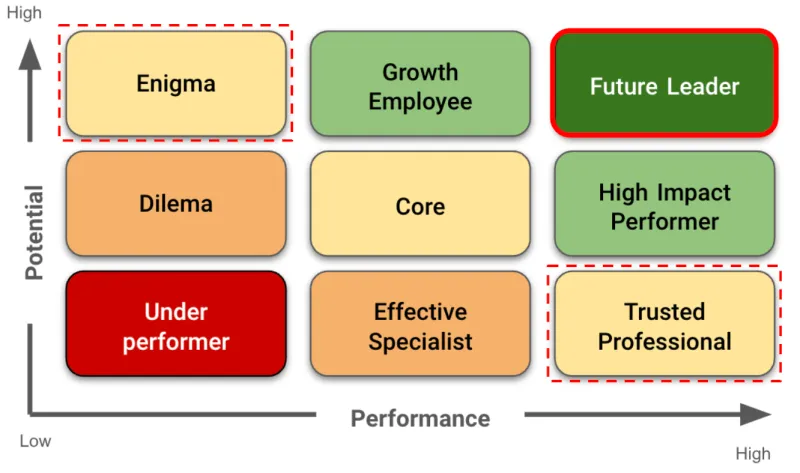
HiPo 9 box grid, Nine Box Grid showing HiPo talent
High Performance Is Not High Potential
Equally important is the distinction between high Performance and high Potential. A criticism of inaccurate HiPo nominations is that managers look to their high-performing staff as ideal candidates. It’s a simple mistake to make; the team members who always deliver would naturally be those you want closest to you, working on the most difficult projects and leading teams. Yet, past performance is not a direct correlation to successfully taking on crucial leadership roles. To bring this into light, statistics show that only one in seven high Performers are actually HiPo employees.
The 'Trusted Professional' talent segment of the 9 box grid illustrates this beautifully—these employees excel in their current roles due to their subject matter expertise but are well placed in role (aka low/reached potential) as they do not possess or desire the broader competencies needed for people-management or leadership.
This highlights a common misstep: promoting and investing significantly in developing leadership competencies of ‘Trusted Professionals’. Considering their stellar past performance alone, without considering their Leadership Drive, Social Aptitude, and Ability, results is a phenomenon known as the Peter Principle, which is well-documented to have detrimental impacts on the individual, team dynamics and overall organisational performance.
A Clearer Path to Identifying HiPos
Accurate HiPo identification requires a nuanced understanding of a trio of observable behaviours: Leadership Ability, Drive, and Social Aptitude. These components form the Potential Profile of the leadership role in consideration.
Key traits within these categories may include:
-
Ability: Marks of cognitive agility such as a relentless pursuit of knowledge, curiosity, adaptability, strategic foresight, critical thinking, creativity, and an entrepreneurial drive.
-
Social Aptitude: Emotional intelligence aspects crucial for managing oneself and others effectively. Traits include resilience, integrity, seeking feedback, political acumen, and the power to inspire others.
-
Drive: The ambition and motivation to embrace the challenges of leadership, characterised by tenacity, challenging the status quo, innovation, a global perspective, and proactivity.
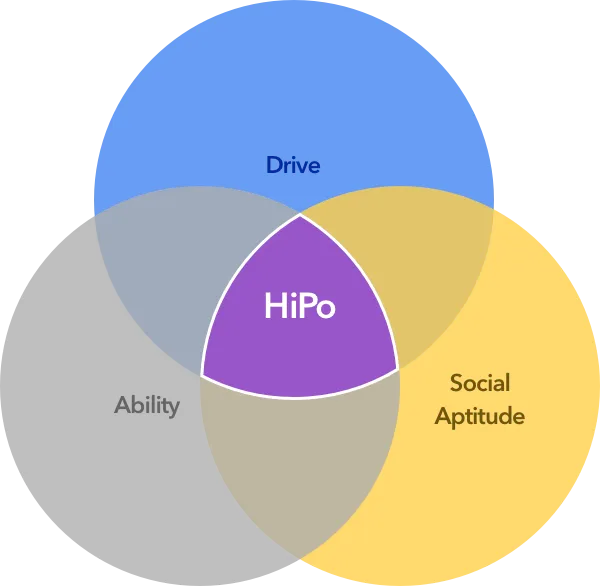
Observable Behavioural Traits of HiPo Staff, The intersection of Ability, Social Aptitude and Drive
Identifying HiPo employees through a data-driven lens means assessing Potential based on observable behaviours and correlating Performance with concrete outcomes from end-of-year reviews. This elite group stands out not just through their innate ability to excel in their current position (High Performance) but also by exhibiting observable behavioural traits that signal their readiness to take on strategic leadership roles that are essential for business outcomes (High Potential). Accurately performed, the 'Future Leader' box of the 9-box grid will showcase your organisation’s true HiPo talent, worthy of significant developmental investment.
HiPo Talent: Your Strategic Investment
The intrinsic value of HiPo employees lies in their capacity to act as catalysts for organisational growth and transformation. Investing in a HiPo goes beyond a simple development expenditure; it's a strategic investment in the organisation's future, yielding exponential returns through innovation, agility, and a culture of high performance. These individuals are your true invaluable assets; identify them correctly, engage them and retain them - they are pure gold.