
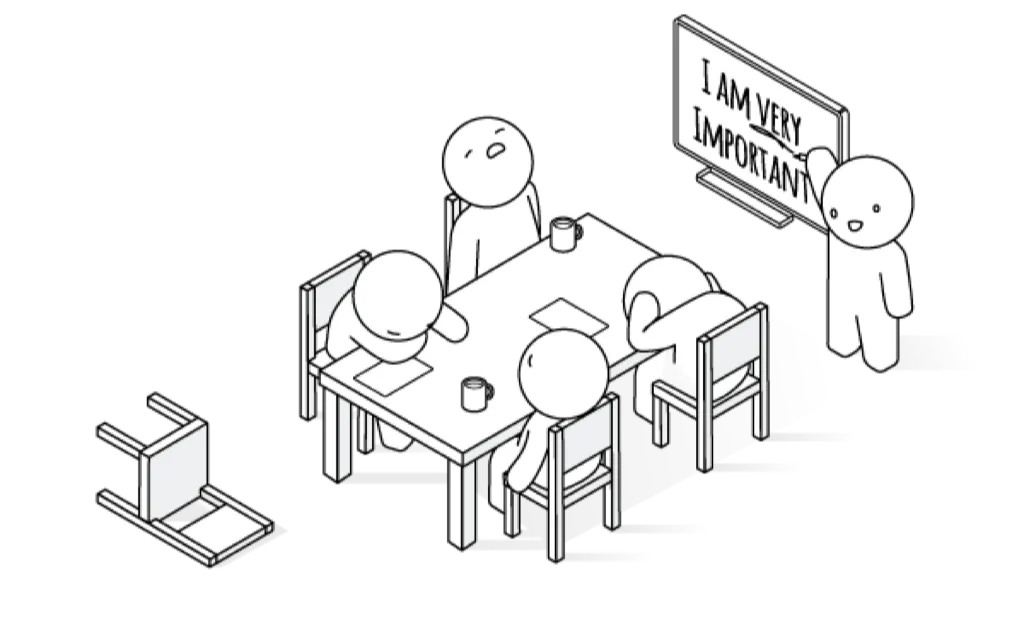
Here’s what happened when I scrapped all recurring meetings
Why banning all recurring meetings was the best decision I ever made.
(Updated: )

Matt Casey
Co-Founder of DoThings.
If there is a hell, I have the unfortunate knowledge of already knowing what mine will me. I will be spending eternity in recurring meetings. I’ll have to listen to someone talk about all the things they did last week that don’t affect me, while someone else asks them questions about those things that don’t affect anyone. I’ll have to pretend to care about over-elaborate PowerPower. I’ll have to listen to people use the word ‘action’ as a transitive verb. If the universe is a cruel and terrible place, this will be my eternity. Hopefully I’ll just be on fire. Thankfully, whilst I occupy my wretched mortal form, I don’t have to suffer recurring meetings at all. Several years ago, I outlawed all recurring meetings, and have never looked back.
When I decided to do this, nobody was onboard. They agreed that the meetings were dreadful, but they were convinced they were a necessary evil. I’m not a fan of putting my foot down, but I really wanted to see what would happen without them. So, we agreed to just try it. We agreed we’d stop having recurring meetings, but if everything was a disaster, we’d start having them again. The worst thing that could happen was a couple of weeks of disruption, and frankly disruption was our default state anyway.
That was on Monday. By Wednesday, we’d unblocked everything that had been blocked, the right people were having the right conversations at the right time, and I no longer wanted to shut the entire company down and just go back to bed.
This will seem like a subject change, but stay with me. During my twenties, I was a smoker. Thankfully I didn’t find quitting difficult at all, and one of the reasons for that was the excellent book The Easy Way to Stop Smoking. What made this book unique was that it didn’t attempt to tell you all the reason not to smoke; cancer, cost, smell etc. Instead, it deconstructed every reason you thought you had for smoking in the first place. What the author managed to do was make you realise that you didn’t even want to smoke anyway, so you might as well not bother. So many of the lessons I learned in that book apply to recurring meetings.
For example, one of the things smokers believe is that smoking reduces stress. This is because, when you’re a smoker, you feel less stressed when you have a cigarette. However, what you don’t consider is that having a cigarette wouldn’t reduce the stress of a non-smoker at all. The stress a smoker is removing by smoking a cigarette is the stress of needing a cigarette to being with. They aren’t solving anything other than a problem they themselves created. The book equates this to wearing an unbearably tight pair of shoes all day, just to feel the relief of taking them off for five minutes once every couple of hours.
With recurring meetings, we fall into the same trap. The recurring meeting blocks communication for a whole week while we wait for the time we’re allowed to talk to each other, then it finally unblocks us when we get in the meeting, and we think the meeting helped us. We’ve parked things that we really could have just talked about right away, so by the time the meeting comes around everyone has a huge amount to talk about, and we all think “Wow, how would we cope without this meeting!?“. The truth is that the meeting caused the problem. Conversations that could have happened a week ago are happening far too late, decisions have been delayed, and work wasn’t being done that could have been done. The meeting is only solving a problem that the very existence of the meeting created.
The recurring meeting persists from an age where it was the best solution, because we didn’t have the technology we have today. When the only way to share information with a large group of people was to physically bring them together, scheduling a recurring meeting made a lot of sense. You couldn’t realistically round everyone up every single time someone needed to discuss something, so you accepted that the only way to work was to have a scheduled time and place where you’d all get together to discuss things. That’s no longer necessary. Technology allows us to have these group conversations on the fly. We do it every day. Most of us constantly interact with several different WhatsApp groups or Teams or Slack channels. We don’t need to schedule a time we all have those conversations, we just throw information into them when we want to say something, and we read the information they contain when we’re free to listen. It’s easy, it’s something we’re all doing anyway, and it really should have signalled the death of the recurring meeting. But it didn’t, most companies still have huge numbers of these meetings. When I’ve been asked to help clients improve their efficiency, I almost always find that everyone attends at least one recurring meeting every single day. This is destroying their productivity for two reasons. Firstly, it means people’s time is far too structured, forcing people to think about things at specific times instead of just dynamically focussing their energy where it’s most needed. Secondly, it constantly disrupts people from their flow state, which for most jobs in a modern company is a prerequisite for delivering good work.
One of the big push backs I got when I first decided to abolish recurring meetings was that people believed it would be impossible to get enough of one another’s time “Hannah is always so busy” I kept hearing “I need to get time booked in or I’ll never get to discuss things with her”. But Hannah is only so difficult to get hold of because she is constantly in recurring meetings. If she didn’t have those meetings, anyone would be able to contact her whenever they needed her. Getting rid of these meetings allows for agile, dynamic conversations to happen as and when they need to, with no fluff or time wasted around them. In a typical recurring meeting, most attendees really don’t need to be involved in about 70% of the conversations that go on. Given that people are often spending half their days in recurring meetings, that’s a lot of wasted time.
When you add up your scrum ceremonies, your one one ones, your departmental meetings, your steering groups, your all hands, at the end of it you’re left with almost no time for any actual work to take place. When your job is creative - which 99% of the jobs in a modern company are in some way or another - the most valuable thing you can have is an uninterrupted block of time. Recurring meetings strip these opportunities to nothing. I have frequently worked with clients where not a single employee ever has the chance to work a single full day uninterrupted. The waste is staggering.
The technology we have available now means we no longer need to subject people to these interruptions. Messaging apps, people intelligence platforms, and collaboration tools make recurring meetings completely unnecessary. It’s been years since I’ve attended one, and work is immeasurably better as a result.
In summary: don’t smoke, don’t wear uncomfortable shoes, and don’t waste your time with recurring meetings.